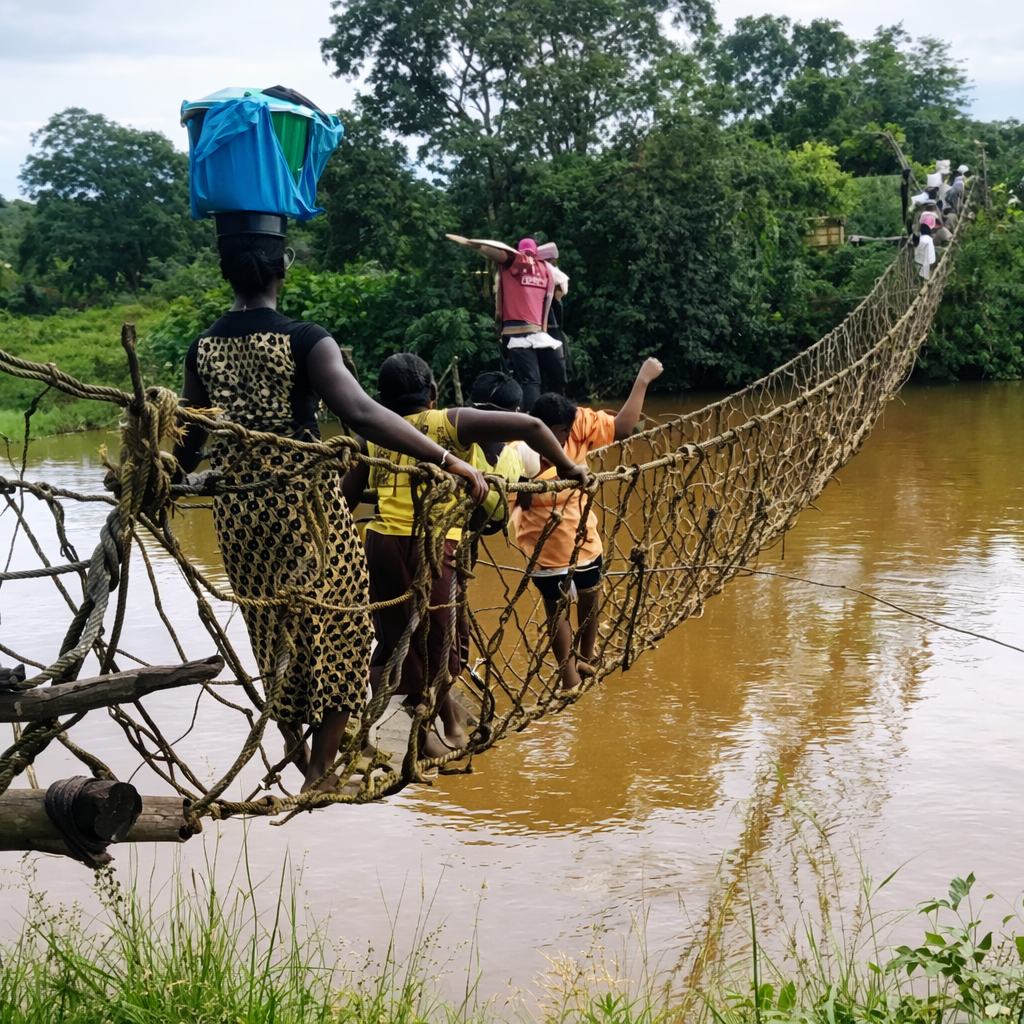
Dawn breaks over the river between Timbo and Kégnéko. Aissatou balances a basin of mangoes on her head, her 3-year-old son strapped to her back. Ahead of her stretches a vine bridge—handwoven ropes and wooden planks suspended 20 feet above rushing water.
She takes a breath, grips the rope rail, and steps onto the first plank. It sways. The wood is rotting in places. One rope shows signs of fraying. She knows two people have fallen to their deaths from this bridge in the past year. But **this is the only way to market.** If she doesn't cross, her family doesn't eat.
**Every single day, over 3,000 people make this crossing.** Students going to school. Patients heading to the health center. Farmers taking goods to market. Pregnant women on their way to give birth. All of them, every day, risking everything just to access basic necessities.
A proper bridge would cost $500,000. That's it. That's all that stands between daily terror and safe passage.
When Infrastructure = Life or Death
In wealthier countries, we take infrastructure for granted. Roads, bridges, electricity—they're just there, invisibly enabling everything we do. We don't think about them until they fail.
In Timbo, **infrastructure isn't just about convenience. It's about survival.**
Without that bridge, children can't get to school (the secondary school is on the other side). Sick people can't reach the health center. Farmers can't sell their produce at market. Women giving birth must choose between a dangerous crossing or delivering alone without medical help.
**The bridge isn't just connecting two riverbanks. It's connecting people to education, healthcare, economic opportunity, and safety.**
The Real Cost of Poor Infrastructure
Let's talk numbers. Because the absence of proper infrastructure isn't just inconvenient—it's economically devastating.
Lost Education
85 students from Kégnéko attend secondary school in Timbo. During rainy season, when the river rises and the bridge becomes even more dangerous, **attendance drops 40%.** Students miss weeks of school because parents won't let them risk the crossing. Lost education = lost opportunity = perpetuated poverty.
Lost Income
Farmers on the Kégnéko side lose an estimated **30% of their crop value** because they can't reliably transport produce to Timbo's market. Mangoes, oranges, vegetables rot before they can be sold. Or farmers accept drastically reduced prices from middlemen who are the only ones with vehicles that can make the long detour.
Lost Lives
Medical emergencies on the Kégnéko side are death sentences. A child with severe malaria. A woman hemorrhaging after childbirth. A farmer with a snake bite. The health center is just 2km away—**but it might as well be 200km when that vine bridge stands in the way.**
What a $500,000 Bridge Actually Provides
When TAD Charitable Foundation builds a bridge, we're not just laying concrete and steel. We're constructing a pathway to prosperity. Here's what $500,000 actually buys:
🌉 Your Bridge Investment Includes:
Physical Structure:
- Reinforced concrete foundation and supports
- Steel beam framework (rust-resistant)
- Durable wooden planking (treated for weather resistance)
- Safety railings on both sides
- Anti-slip surface treatment
- Load capacity: 500kg (safe for vehicles)
Community Benefits:
- Safe passage for 3,000+ people daily
- Year-round access (no seasonal closures)
- Connects 2,000+ residents to essential services
- Enables emergency vehicle access
- Opens market access for 150+ farmers
- Ensures 85 students can attend school safely
- 30-year lifespan with minimal maintenance
Think about that return on investment. **$500,000 once = 30 years of safe passage for thousands of people.** That's less than $17,000 per year. Less than $50 per day. **For infrastructure that literally saves lives and creates economic opportunity for an entire community.**
Before and After: The Transformation
Let me paint you two pictures of the same community—one with the vine bridge, one with a proper bridge. The difference is staggering.
Before: Life with the Vine Bridge
**Morning:** Aissatou waits for the river to calm before attempting to cross with her baby. She's been waiting 2 hours. The mangoes are ripening fast—if she doesn't sell today, they'll spoil. But crossing now would be too dangerous.
**Afternoon:** A student named Ibrahim should be at school, but his mother kept him home. The bridge was swaying too much in the wind this morning. He's missed 8 days of school this month for the same reason.
**Evening:** An elderly man has chest pains. His family debates—risk the bridge in darkness to reach the health center, or hope he makes it through the night? They wait. By morning, he's worse. The detour takes 3 hours. He dies before reaching help.
After: Life with a Proper Bridge
**Morning:** Aissatou walks confidently across the bridge, baby on her back, mangoes on her head. The crossing takes 3 minutes. She reaches market early, gets the best prices, returns home in time to prepare lunch for her children.
**Afternoon:** Ibrahim runs across the bridge with his classmates, laughing. His attendance is perfect. His grades are improving. His teacher says he might qualify for a scholarship to university.
**Evening:** A motorcycle taxi rushes the elderly man across the bridge and straight to the health center. He receives immediate treatment. He survives. He returns home to his grandchildren.
**Same people. Same place. Different bridge. Different outcomes.**
Build More Than a Bridge
A bridge isn't just wood and steel. It's opportunity. Safety. Hope. Your $500,000 investment connects dreams to reality for 3,000 people.
Be the bridge builder.
Fund a Bridge Project🌉 $500,000 = Full bridge | $50,000 = Major donor | $10,000 = Foundation pillar | $1,000+ = Bridge supporter
Major Donor Recognition: Leave a Legacy
Infrastructure projects offer a unique opportunity for lasting impact. When you fund a bridge, **your contribution literally stands for generations.** We recognize major donors in meaningful, permanent ways:
⭐ Bridge Builder Recognition Levels:
- $500,000 - Namesake Bridge Builder: Bridge named in your honor with permanent plaque. Annual ceremony with community. Lifetime recognition as the person who connected two communities.
- $100,000 - Foundation Pillar: Your name on the bridge foundation plaque. Recognition in all project materials. Invitation to opening ceremony.
- $50,000 - Community Champion: Name on community recognition board. Certificate of impact. Photo documentation of completed bridge.
- $10,000 - Bridge Supporter: Name in bridge completion booklet. Digital impact report. Thank you from community leaders.
Imagine visiting Timbo someday and seeing **your name on a bridge that thousands of people cross safely every day.** Imagine meeting the students who can now attend school, the mothers who can reach the health center, the farmers who can sell their crops—all because you decided to build a bridge.
**That's not just charity. That's legacy.**
Why TAD Charitable Foundation for Infrastructure?
Infrastructure projects can be complicated, expensive, and prone to corruption or mismanagement. That's why TAD Charitable Foundation's approach is different:
**Local Partnership:** We work with local engineers and builders who know the terrain, the materials, and the community needs.
**Community Ownership:** Before construction begins, we establish a bridge maintenance committee from local residents. They take ownership and pride in keeping the structure safe.
**Transparent Costs:** Every dollar is accounted for. We provide detailed budgets, progress photos, and completion reports. No overhead, no kickbacks, no waste.
**Lasting Impact:** We don't just build and leave. We train locals in basic maintenance, establish inspection schedules, and stay connected to ensure the bridge serves the community for decades.
The Ripple Effect: Beyond the Bridge
Infrastructure doesn't just solve one problem—it creates a cascade of opportunities. When we built our first bridge in 2024, here's what happened:
**Month 1:** School attendance increased 35%. Teachers reported better focus and engagement from Kégnéko students who were no longer missing classes.
**Month 3:** Two small businesses opened on the Kégnéko side—a grocery store and a phone charging station. Both cited "reliable access to supply trucks" as the reason they could finally open.
**Month 6:** Emergency response times to Kégnéko improved from 3+ hours to 15 minutes. One life saved in a medical emergency that would have been fatal before the bridge.
**Year 1:** Average household income in Kégnéko increased 28%. Farmers could get produce to market reliably. Workers could commute to jobs in Timbo. Economic isolation ended.
**That's what a bridge does. It doesn't just connect riverbanks—it connects people to possibility.**
Your Decision: Build or Wait
Right now, as you're reading this, someone in Kégnéko is looking at that vine bridge and making calculations. Is it too windy? Is the river too high? Can they risk it today?
**You have the power to end that fear.**
$500,000 seems like a lot of money. And it is. But this is a major infrastructure project that will serve thousands for decades. Major donors can fund the full bridge. Foundations can contribute $50,000-$100,000. Individual donors can give $1,000, $5,000, or $10,000 toward the bridge fund. Every contribution brings this life-saving infrastructure closer to reality.
**It's not one person's burden—it's a community effort.** And the result? **3,000 people cross safely. Every single day. For the next 30 years.**
3,000 People Are Waiting
Tomorrow morning, Aissatou will wake up and face that vine bridge again. Will it be the last time she has to risk her life just to sell mangoes? **That depends on what you do next.**
Be a Bridge Builder TodayTax-deductible | 501(c)(3) nonprofit | EIN: 39-4803127 | 100% to construction
"A bridge is more than an engineering marvel; it's a promise that no river is too wide to cross, no dream too far to reach."